How to Play Hearts (Card Game): Rules & Strategy Guide
Pass three cards, follow suit, avoid penalty points and understand the house rules that change the opening lead or when hearts are broken.
This guide uses the heart-only breaking convention and labels player-count and first-trick house rules. Play without money stakes.
Hearts is the rare card game where winning a hand can actually be the worst thing that happens to you. Most trick-taking games reward you for scooping up cards; this one quietly punishes you for it, and the first time you accidentally win a trick full of hearts, you'll understand why everyone at the table just groaned. Here's the full rundown, including a few details that most rule pages either skip or get slightly muddled.
What Is Hearts?
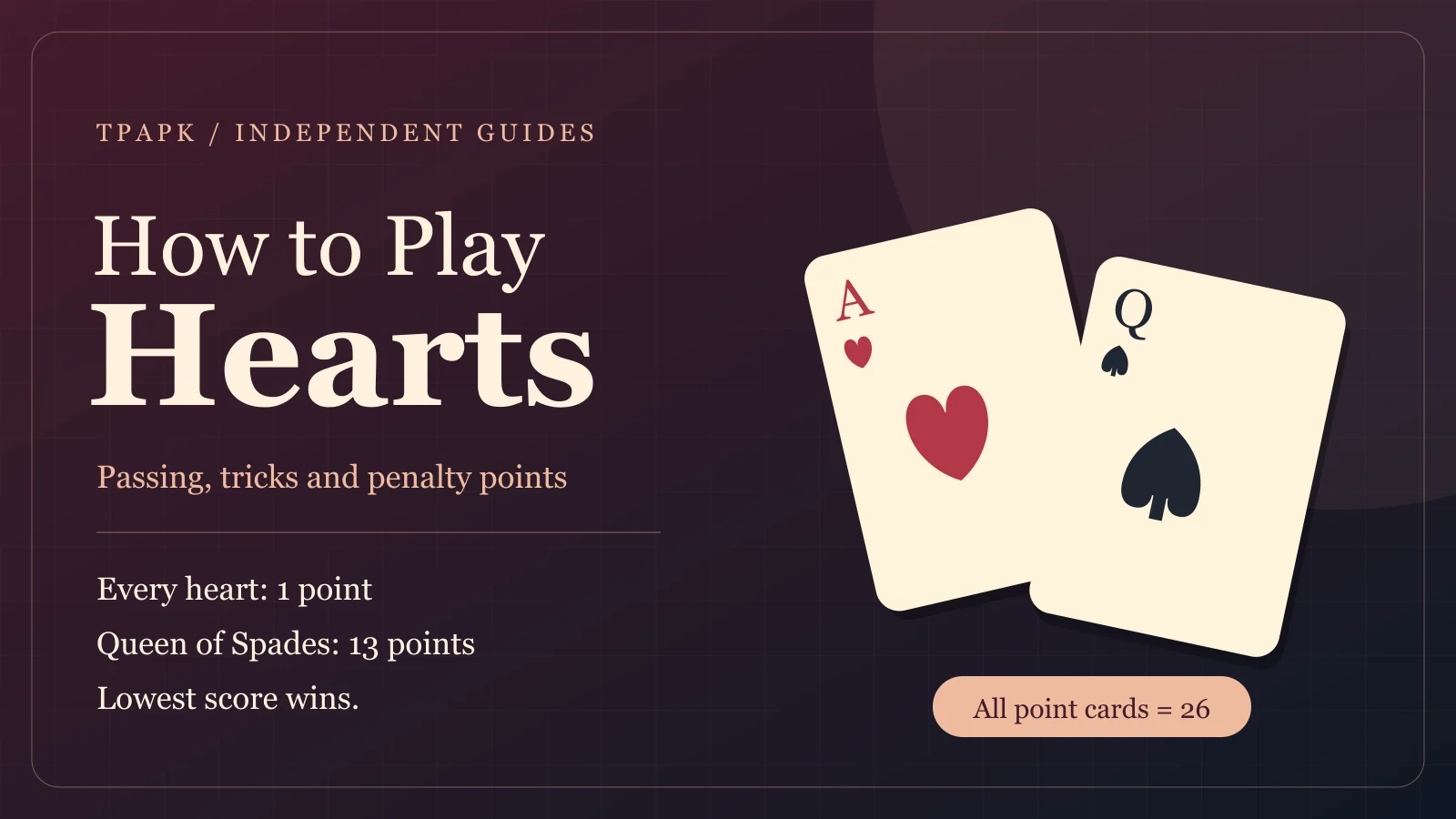
Hearts is a trick-taking card game for four players (though 3, 5, and 6 also work with small deck adjustments) where the goal is backwards from what you'd expect: you're trying to avoid certain cards, not collect them. Every heart in the deck is worth a penalty point, and the Queen of Spades alone is worth thirteen - as much as every heart combined. Lowest score wins.
What You Need
- A standard 52-card deck (best with 4 players; 3, 5, and 6 are also playable)
- A flat table - seating position matters more in Hearts than in most card games, since play order is fixed for the whole game
Playing with Fewer or More Than 4
The standard game assumes 4 players and a full 52-card deck. Shuffle and deal clockwise, one card at a time, until each player has 13 cards. With other player counts, trim the deck so it divides evenly. The table below is one workable house-rule configuration, not a universal standard. Agree on passing and the opening club after removing cards; the exact low cards chosen can vary without changing the point cards.
| Players | Cards Removed | Deck Size | Cards per Player |
|---|---|---|---|
| 3 | 2♦ | 51 | 17 |
| 4 (standard) | None | 52 | 13 |
| 5 | 2♣, 2♦ | 50 | 10 |
| 6 | 2♣, 2♦, 3♣, 2♠ | 48 | 8 |
The Passing Phase
In the standard four-player game, before anyone plays a card, each player picks 3 cards and passes them face-down, without inspecting the incoming cards first. The direction rotates over four hands: left, right, across, then no passing, and repeats. With other player counts, agree on a passing schedule because an 'across' player may not be defined.
Most guides stop at “pass your high cards,” which is true but not the whole story. A few sharper habits:
- The Queen of Spades is usually worth passing away early if you don't have enough low spades to protect yourself from being forced to take it later.
- Passing away your last card of a suit entirely (going “void”) can be more valuable than passing individually strong cards, since a void suit lets you discard dangerous cards onto tricks you can't win anyway.
- Aces and Kings in short suits are often more dangerous to keep than they look - they tend to win tricks you didn't want to win.
Also Read:- How to Play Mafia Party Game
How to Play a Trick, Step by Step
1. The Opening Lead
Whoever holds the 2 of Clubs after passing leads it first in the standard four-player game. Everyone else then plays clockwise. If the 2 of Clubs was removed for a player-count variant, lead the lowest remaining club instead: 3 of Clubs in the five-player configuration shown above, or 4 of Clubs in the six-player configuration.
2. Follow Suit if You Can
If you have a card in the suit that was led, you must play one of them. If you don't, you're free to play anything - with one important restriction on the very first trick, covered next.
3. The First-Trick Exception
On the first trick, do not discard a heart or the Queen of Spades when you have a non-point alternative. For the rare hand containing only hearts and the Queen, this guide uses a house-rule exception allowing a point card because there is no non-point card to play. Agree on that exception before dealing rather than treating it as universal.
4. Winning the Trick
Whoever played the highest card of the suit that was led wins all four cards in the trick, and leads the next one. The other three suits in the trick don't matter at all for determining the winner - only the led suit counts.
Also Read:- How to Play Rummy Modern
Breaking Hearts, Properly Explained
'Breaking hearts' restricts leading a heart as the first card of a trick. If you cannot follow suit, you may discard a heart after the first trick; that breaks hearts and permits later heart leads. This guide uses the heart-only breaking convention: discarding the Queen of Spades does not itself break hearts. Some rulesets, including Bicycle's published version, also count a Queen discard as breaking hearts, so agree on the convention before playing.
A player whose entire remaining hand consists of hearts may lead one even before hearts are broken, because no other suit is available. If the Queen of Spades remains alongside the hearts, that is a non-heart card that can be led; merely holding hearts plus the Queen does not trigger the all-hearts exception used here.
A Worked Example Trick
Say hearts haven't been broken yet, and it's the third trick of the hand. Deepak leads with the 9 of Diamonds:
Deepak leads 9♦.
Fatima follows suit with the Queen♦.
Sanjay has no diamonds left, so he discards the 4♥ - legal, since it's not the first trick, and this is what breaks hearts for the rest of the hand.
Priya follows suit with the King♦, the highest diamond played.
Priya wins the trick (highest card of the led suit, diamonds) and picks up all four cards, including Sanjay's heart. She now leads the next trick, and because hearts are broken, she's free to lead one if she wants to.
Scoring and Shooting the Moon
After all 13 tricks are played, add up the point cards each player collected: 1 point per heart, 13 for the Queen of Spades. Keep playing hands until someone hits 100 points (or whatever total your table agreed on); lowest total when that happens wins the whole game.
If one player manages to collect every single heart and the Queen of Spades in one hand - all 26 points - that's “shooting the moon.” The standard outcome is that the shooter scores zero for the hand while every opponent takes on 26 points instead. Some tables play a variant where the shooter can choose to subtract 26 from their own running total instead of loading 26 onto everyone else - worth agreeing on before the game starts, since it changes the math in close games.
Strategy Tips (and Why They Work)
Don't win tricks you don't have to, early on. Taking an early trick you didn't need to win often just sets you up to lead the next one into a suit you're not ready to gamble on.
Get rid of the Queen of Spades on someone else's trick, not your own, when the follow-suit rule allows it. If you are void in the led suit and another player will win the trick, discarding her transfers the penalty to that player. Do not discard her while you still hold the led suit, and remember the first-trick restriction.
Track who's run out of a suit. A player who can no longer follow a particular suit is a player who can dump hearts onto your tricks from that point forward - lead that suit carefully once you notice it.
Watch for a moon attempt before it's too late to stop. If one player has taken every point card so far in the hand, deliberately taking a single heart yourself - even though it costs you 1 point - is far better than letting them complete the moon and hand you 26.
Quick Glossary
- Trick - one round where every player plays a card; the highest card of the led suit wins it.
- Lead - the first card played to a trick, which sets the suit everyone else must follow.
- Void - having no cards left in a particular suit.
- Breaking hearts - the first time a heart is played in a hand, after which hearts can be led.
- Shooting the moon - collecting every heart and the Queen of Spades in a single hand.
Related Reading
- Muflis Teen Patti Rules & Rankings
- Teen Patti Master Login, OTP and Customer Care Scam
- How To Master Teen Patti
- UPI Withdrawal Betting Games
- Teen Patti Bonus Terms Explained
- How to Play Mafia (Party Game)
- Dragon Tiger and Teen Patti Master
- How to Play Bluff Card Game
- Best Platforms for Fortune Game Spin in India
FAQs
What does breaking hearts mean?
In this guide's heart-only convention, it is the first heart discarded in a hand. Until then, you cannot lead a heart unless only hearts remain. Follow-suit and first-trick restrictions still apply. Some tables also let the Queen of Spades break hearts; agree before play.
Can you play a heart before hearts are broken?
Yes, when you cannot follow suit after the first trick. On the first trick, use the stated no-non-point-card house exception only if it was agreed. You may lead an unbroken heart only if your entire remaining hand is hearts.
What is shooting the moon?
Winning every heart and the Queen of Spades in a single hand. The shooter scores zero, and every opponent takes on 26 points instead - or, at some tables, the shooter subtracts 26 from their own score.
Can Hearts be played with fewer or more than 4 players?
Yes. With 3, 5, or 6 players, a small number of low cards are removed from the deck so it divides evenly, though the exact cards removed vary a little by table.
Sources and Scope
This guide uses the heart-only breaking convention and labels player-count and first-trick house rules. Play without money stakes.

James Parker
James coordinates TPAPK's evidence standards, final review and corrections. His profile links his editorial scope to the site's published guides.