How to Play Bluff Card Game: Rules, Variations & Strategy
Set up the deck, choose your house rules, make a claim, call a bluff and follow a complete example round.
Picture learning Bluff on the floor of a hallway during a power cut. That's sort of the perfect setting for this game - no board, no batteries, just a pack of cards and a room full of people who are all, to varying degrees, lying to each other on purpose. If you've never played, here's everything you actually need to know, including a few things most guides skip entirely.
What Is Bluff?
Bluff is a card-shedding game built entirely around one idea: you don't have to tell the truth about what you're putting down. Depending on where you learned it, you might know it as Cheat, I Doubt It, or BS - same game, different name, occasionally a slightly different rule or two. The goal is simple to state and much harder to pull off: get rid of every card in your hand before anyone else does, using whatever combination of honesty and nerve gets you there.
What You Need
- 3–10 players (4–6 tends to hit the sweet spot for pacing)
- One standard 52-card deck for smaller groups; grab a second deck once you're past 6 players so there are enough cards to go around
- A flat surface for the discard pile in the middle of the table
[▶ Download Teen Patti Master Now]
Setup
Shuffle the deck and deal every card out, one at a time, going around the table until the deck runs out. It's completely normal for some players to end up with one more card than others - that doesn't affect anything. Everyone looks at their own hand and keeps it hidden from the rest of the table.
Two Ways to Start: Standard vs. Ascending
This is where a lot of guides quietly contradict each other without ever saying so - some tell you to pick any rank you like, others insist you must start at Ace and climb. Both are correct. They're just different traditions that grew up around the same core game, and it's worth knowing both exist so you're not caught off guard at someone else's table:
| Standard Bluff | Ascending Bluff (“BS” style) | |
|---|---|---|
| Starting rank | Whoever goes first picks any rank they like | Always starts at Ace; use the dealer's left or the agreed Ace-of-Spades house rule to choose the first player |
| Rank each turn | Usually stays the same rank until someone changes it, or is agreed on by the group | Climbs by exactly one rank every single turn, Ace to King, then loops |
| Where it's popular | A casual house-rule version; names and details vary by group | The sequential format published as I Doubt It; also known as BS or Cheat |
| Good for | Quick, informal games where nobody wants to memorise a sequence | Groups who want a built-in structure and a natural way to decide who starts |
Neither version is more “official” than the other. Just agree with your table before the first hand which one you're playing, and you'll save yourself an argument three turns in.
Why the Ace of Spades Sometimes Gets Special Treatment
If you've read a few different rule sets for this game, you may have noticed the Ace of Spades pops up in a strangely specific way - in an Ace-of-Spades house-rule version, whoever holds it is expected to go first, playing it down along with any other aces in their hand. Most articles just state this as a rule without explaining what it's actually for. It's not a power card or a wildcard; it's simply a built-in, no-argument way to decide who starts. Instead of the table debating who goes first, the deck itself already decided the moment the cards were dealt. This starting convention is optional: Bicycle's I Doubt It rules instead start with the player to the dealer's left.
if reading a poker face is your thing, our Teen Patti guide is a natural next step
How to Play: Step-by-Step
1. Start the Round
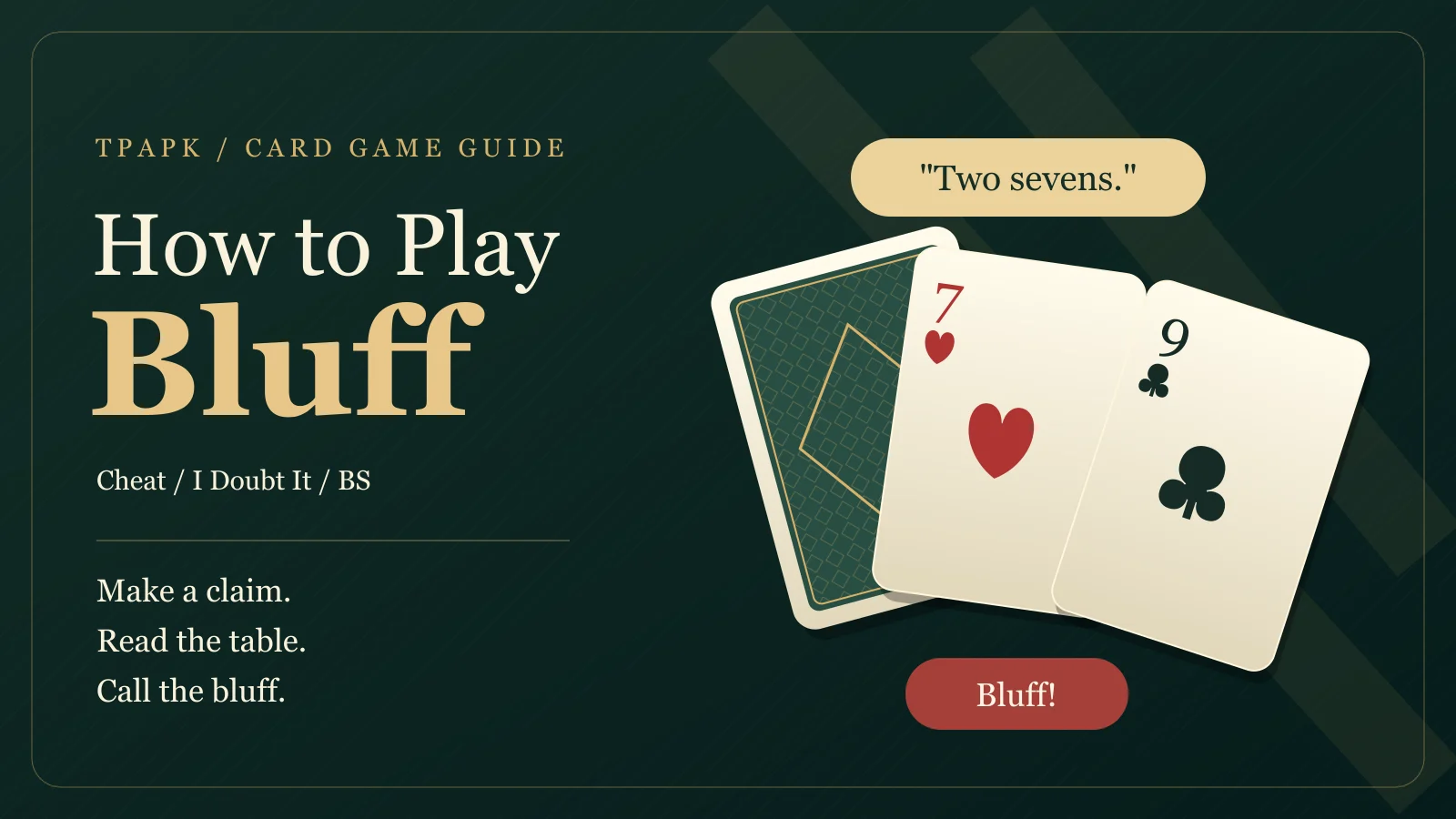
The first player places one to four cards face-down in the middle and announces the agreed rank out loud - for example, on a later turn, “two sevens.” They may be telling the truth. They may not be. In the ascending version, the opening rank is Ace.
2. Play Continues Around the Table
Each player in turn adds their own cards face-down to the same pile, announcing the same rank (in Standard Bluff) or the next rank up (in Ascending Bluff). A player with none of the required rank has two choices: bluff by placing down different cards and announcing the rank anyway, or pass if your table allows it.
3. Call a Bluff
Before the next player places any cards, another player can challenge the most recent play by calling “bluff” (or “cheat,” or “I doubt it” - pick whichever your group prefers). The top cards just played are flipped face-up for everyone to see.
4. Resolve the Challenge
- If the play was a lie, the player who bluffed picks up the entire pile.
- If the play was actually true, the challenger picks up the entire pile instead.
In the ascending rules used in this guide, once the pile is picked up, the player sitting immediately after whoever just played (not whoever picked up the pile) starts the next turn, at the next rank up if you're playing the ascending version. Agree on any different restart rule before playing.
5. Keep Going Until Someone's Out
The round continues, pile growing, until one player has no cards left in hand. That player wins only after the final play goes unchallenged or is challenged and shown to be truthful. Most groups keep playing to sort out second and third place too, since the game only gets more paranoid as fewer players remain.
Another great bluffing game: learn Mafia
A Worked Example Round
Reading the rules in the abstract only gets you so far, so here's what an actual sequence looks like at a four-player table - Raj, Meera, Arjun, and Priya - playing the ascending version:
Raj holds the Ace of Spades, so he starts. He places two cards face-down: “Two Aces.” He's telling the truth.
Meera goes next, needs 2s. She only has one, so she adds a second random card and says “Two 2s.” She's bluffing.
Arjun, suspicious of how fast Meera played, calls “Bluff!” The cards flip - one 2, one 9. Meera lied, so she picks up the whole four-card pile.
Play moves to Arjun (the player after Meera, where the bluff happened), who starts the next rank: “Three 3s.”
Notice that Arjun, who made the correct call, also plays next here - not because he challenged, but because he was next in line after Meera's challenged play. If Priya had made the call, Arjun would still play next. That single detail trips up more first-time groups than almost anything else in the rules.
Common Variations
These labels and house rules are not interchangeable official standards. Agree on the turn order, card limit and challenge timing before playing.
| Variation | What's Different |
|---|---|
| Cheat / BS | Alternative names for the same bluffing family; agree on the rank sequence and challenge rules rather than relying on the name alone. |
| I Doubt It | Bicycle's I Doubt It rules allow one to four face-down cards per turn. This is not unique to the name I Doubt It; some groups instead agree on a smaller limit. |
| Chinese Bluff | A free-rank house rule sometimes labelled Chinese Bluff: you can announce any rank on your turn, within the table's agreed card limit. The label does not establish a universal ruleset. |
| Swedish Bluff | A reverse-order house rule: start at King and count down to Ace. The label Swedish Bluff is not a universal rules standard, so confirm the rules with your group. |
Strategy Tips (and Why They Actually Work)
Don't bluff every single turn. If you're always lying, sharp opponents will start challenging you by default, and eventually they'll be right. Mixing in genuinely true plays resets their read on you.
Keep a rough count of what's already been played. In a single-deck game there are only four Jacks: if all four are genuinely accounted for in your hand or in the current pile, a claim to another Jack cannot be true. Claims alone do not prove which cards were played, and cards picked up after a challenge can return to the pile later. With two decks there are eight Jacks, so adjust your count.
Play at a consistent pace, bluff or not. Hesitating specifically when you're lying is the single most common tell in this game. If you slow down every time you're bluffing, people will learn your rhythm within a few rounds.
Don't challenge everything. Calling bluff and being wrong hands you the entire pile, which can undo several turns of progress in one guess. Save your challenges for plays that genuinely don't add up.
Watch for someone shedding cards suspiciously fast near the end. A player who's down to two or three cards and playing quickly is often relying on nobody wanting to risk a challenge this late in the round - which is exactly when a well-timed challenge tends to pay off.
More card and party game guides
Quick Glossary
- Pile - the growing stack of face-down cards in the middle of the table.
- Rank - the card value being announced (e.g. “threes,” “Jacks”), true or not.
- Challenge / Call - accusing the last player of lying about their cards.
- Catch - successfully proving someone was bluffing.
- Clear - emptying your hand completely, which wins the round after any challenge to the final play is resolved.
Related Reading
- Muflis Teen Patti Rules & Rankings
- Teen Patti Master Login, OTP and Customer Care Scam
- How To Master Teen Patti
- UPI Withdrawal Betting Games
- Teen Patti Bonus Terms Explained
- How to Play Mafia (Party Game)
- Dragon Tiger and Teen Patti Master
- How to Play Bluff Card Game
Frequently Asked Questions
Is Bluff the same game as Cheat, BS, or I Doubt It?
Yes - these are regional names for essentially the same game, with small rule differences depending on the version your group plays.
Can you bluff on your last card?
Yes, and it's usually the riskiest moment to try it - opponents tend to challenge a conveniently timed final play far more often than an ordinary one. You win only if the final play goes unchallenged or is revealed to be truthful.
What happens if no one calls a bluff?
Nothing dramatic - play simply moves to the next player, and the cards stay face-down in the pile as if the claim were true, lie or not.
Why do some versions set aside the Ace of Spades?
It's a built-in way to decide who starts the round in an ascending house-rule version, so nobody has to argue about it. It remains a normal Ace dealt to a player, not a removed card or wildcard; other rules start with the player to the dealer's left.
Rule Reference
The ascending rules and final-play condition were checked against Bicycle's I Doubt It rules. Ace-of-Spades starts, passing, free-rank play and reverse rank order are house-rule choices, not universal requirements. This guide describes a physical, no-money card game; the linked APK page is a separate resource and does not establish that the app includes Bluff.

Ava Mitchell
Ava is TPAPK's Hindi Editor. This card-game guide is listed in her published work; her profile explains her documented editorial scope.