Indian Rummy (13 Cards): Complete Rules & How to Play
Learn Indian 13-card rummy setup, pure sequences, sets, turns, scoring, common formats and beginner strategy.

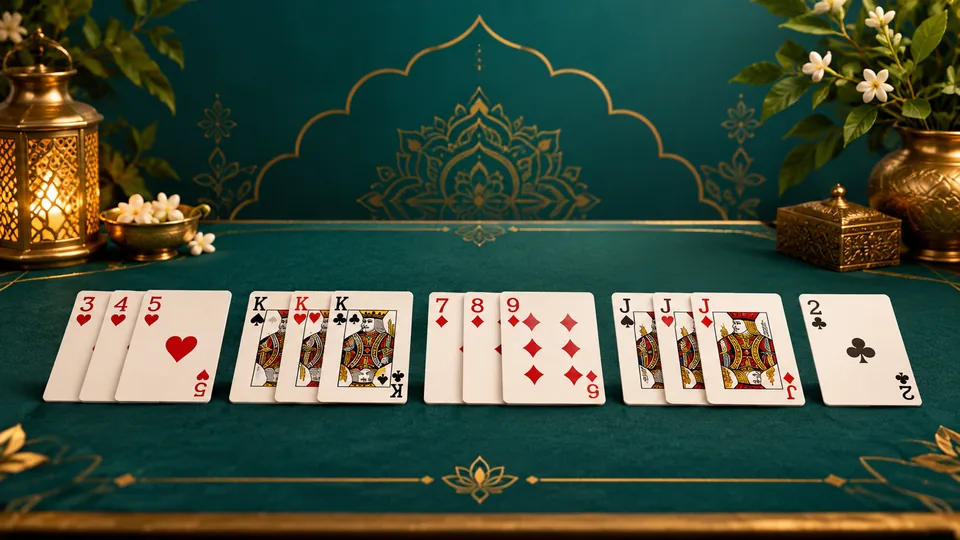
Deck counts, joker use, scoring, drop penalties and declarations can vary by table or platform. Check the rules before a game; legal treatment also depends on the activity and jurisdiction.
There's a specific kind of quiet that falls over a Rummy table in the last few turns before someone declares - everyone's gone from chatting to doing math in their head, recounting the discard pile, trying to remember if that 9 of clubs is still alive. It's a slower burn than most card games, which is exactly what makes it satisfying once your hand finally clicks into place. Here's the full rulebook, including a few details most guides gloss over.
What Is 13 Card Rummy?
Indian Rummy, almost always called 13 Card Rummy, is a draw-and-discard game where the goal is to arrange your entire hand into valid runs and groups faster than everyone else at the table. It rewards planning far more than luck - which is exactly why it's classified as a game of skill rather than a game of pure chance in most legal discussions around it.
What You Need
● 2–6 players
● One or two standard 52-card decks, including printed jokers, depending on player count (see the table below)
● A flat surface for the closed deck and the open discard pile
How Many Decks Do You Actually Need?
This is the detail most rule pages either skip or state as if it never changes. It does:
| Players | Decks Used | Total Cards in Play |
|---|---|---|
| 2 | 1 deck + 2 printed jokers | 54 |
| 3–6 | 2 decks shuffled together + 4 printed jokers | 108 |
Setup
The dealer shuffles and deals 13 cards to each player, one at a time. The remaining cards form the closed deck in the middle. One card is turned face-up beside it to start the open discard pile. A second card is then drawn and set aside, face-up, to become the round's wild joker - every card of that same rank, across all four suits, becomes wild for the rest of the hand.
Related Article:- How to Play Rummy Modern
The Building Blocks: Sequences and Sets
Sequence: three or more consecutive cards of the same suit. A pure sequence uses no joker at all; an impure sequence uses one or more jokers to fill a gap.
Set: three or four cards of the same rank, each from a different suit. Sets can use jokers freely.
To make a valid declaration, you need at least two sequences, and at least one of them has to be pure. Everything else in your hand needs to sit inside a valid sequence or set - no card is allowed to sit outside a group when you declare.
Why the Pure Sequence Rule Exists
Almost every guide states this rule without ever saying why it's there, which makes it feel arbitrary. It isn't. Since jokers can substitute for literally anything, a hand built entirely from impure sequences and sets could theoretically be completed mostly by luck - drawing the right wild joker rank at the right time. Requiring one genuine, joker-free run forces every winning hand to prove at least some real card-reading and sequencing skill, rather than winning purely off a lucky joker draw.
How to Play: Step-by-Step
1. Draw
On your turn, take either the top card of the closed deck (unseen) or the visible top card of the open discard pile.
2. Rearrange Your Hand
Fit the new card into your sequences and sets however it helps, mentally or physically reordering your hand as needed.
3. Discard
Place exactly one card face-up on the discard pile, bringing your hand back down to 13. Choose carefully - a card you don't need might be exactly what an opponent is waiting for.
4. Declare When Ready
Once your 13 cards form at least two sequences (one pure) with everything else in valid groups, you can declare: draw your final card, place it face-down in the finish slot without adding it to your hand, and show your arrangement. If it's valid, you win the hand.
Related Article:- How to Play Hearts Cards
A Worked Example Hand
Here's what a completed, declarable hand actually looks like, card by card:
4♥ 5♥ 6♥ - a pure sequence (no joker used).
9♣ 10♣ J♣ Q♣ - a second sequence, also pure in this case, satisfying the “two sequences” requirement entirely with real runs.
8♠ 8♥ 8♦ - a set of three 8s across different suits.
K♠ K♥ [Joker] - a set using one wild joker to stand in for the third King.
That's all 13 cards accounted for, two sequences (both pure, which is even stronger than the minimum requirement), and two sets, one of them helped along by a joker. This hand is ready to declare.
Dropping Out: The Three Penalty Tiers
Sometimes your hand is simply unworkable, and getting out early costs far less than staying in and losing badly. There are three distinct penalty levels, and mixing them up is a common beginner mistake:
| Drop Type | When It Happens | Typical Penalty |
|---|---|---|
| First (Initial) Drop | Before picking up a single card on your first turn | 20 points |
| Middle Drop | After playing at least one turn, but before declaring | 40 points |
| Full Count | You're still in when someone else declares, and your hand isn't validly arranged | 80 points |
Scoring Reference
| Card | Points If Left Unmatched in Hand |
|---|---|
| Ace, King, Queen, Jack | 10 points each |
| Number cards (2–10) | Face value (a 7 costs 7 points, and so on) |
| Joker (printed or wild) | 0 points |
When a hand ends, the player who declared scores zero for that hand (assuming a valid declaration), and everyone else totals the point value of whatever cards are left unmatched in their hand.
Common Formats You'll Hear About
● Points Rummy - a single, fast hand; whoever declares first wins outright based on the points difference.
● Pool Rummy - players keep accumulating points across multiple hands until they're eliminated at a set total (commonly 101 or 201).
● Deals Rummy - a fixed number of hands are played (commonly 2 or 3), and whoever has the lowest total points when they're all finished wins.
Related Article:- Teen Patti Sequence Explained
Beginner Strategy
Chase your pure sequence first. Nothing else about your hand matters if you can't complete this one non-negotiable piece, so prioritise it before worrying about sets.
Hold onto middle cards longer than high cards. A lone King or Ace is expensive to be caught holding and often harder to turn into a set quickly - discard isolated high cards earlier rather than later.
Watch what your opponents pick from the open pile. Picking up a discarded card (rather than drawing blind) reveals real information about what they're building - far more than a blind draw does.
Don't hoard jokers. It's tempting to stockpile them, but an unused joker usually counts as zero points if someone else declares first, but it cannot help complete a group until you use it. Use them as soon as they complete something.
FAQs
How many decks are used in 13 Card Rummy?
One deck for 2 players, and two decks shuffled together for 3 to 6 players.
What is a pure sequence and why is it required?
Three or more consecutive cards of the same suit, with no joker involved. It's required because it proves you can build a genuine run rather than winning purely off a lucky joker draw.
What happens if I drop out of a Rummy game?
An initial drop before your first turn typically costs 20 points, a middle drop after you've played at least once costs 40, and being caught with an invalid hand when someone else declares costs a full 80.
Is a set required to win, or just two sequences?
Just two sequences, one of them pure. Sets are optional - any remaining cards simply need to sit in valid sequences or sets, not specifically both.