Teen Patti Sequence Explained: Pure Sequence, A-2-3 & Rules
Compare sequences and pure sequences, understand A-2-3 house rules and work through three-card hand examples.
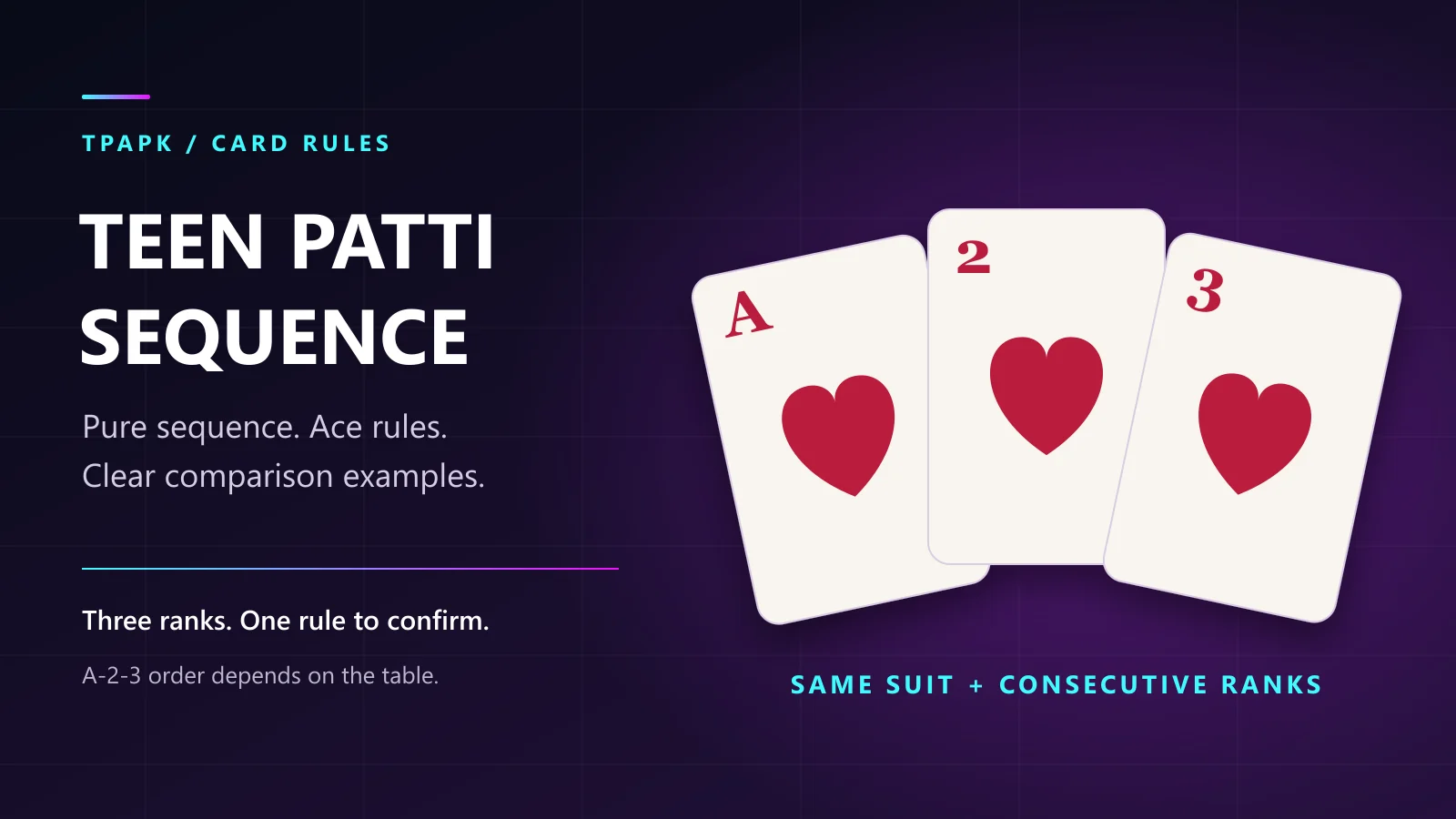
This guide assumes a standard 52-card deck, three-card hands and no jokers. Sequence order is a house rule: check the rules displayed by your table or app before comparing A-2-3. The examples are not confirmation of a particular app build.
Somebody at almost every Teen Patti table eventually holds up an Ace, a 2, and a 3, and the table splits into two camps: half insist it's one of the strongest hands you can hold, the other half insist it's barely better than nothing. Both sides usually walk away convinced the other one is misremembering the rules. They're not, really — they're just remembering two different, both legitimate, versions of the same rule. This page exists mainly to sort that out properly, along with a couple of other sequence details that most rule pages either skip or get slightly wrong.
What Is a Sequence in Teen Patti?
A sequence, sometimes called a run or a straight, is three cards in consecutive rank order — something like 7, 8, and 9. The suits don't need to match. If they do happen to match, you've actually got something stronger, which brings us to the hand everyone gets excited about.
Also Read:- Basic Rules of Teen Patti
What Is a Pure Sequence?
A pure sequence (also called a straight flush, or “pakki” sequence in a lot of Hindi-speaking tables — “pakki” roughly meaning “solid” or “the real thing”) is the same idea with one extra requirement: all three cards have to share a suit as well as sit in consecutive order. 7, 8, and 9 of hearts qualifies. 7 of hearts, 8 of spades, and 9 of diamonds does not — that's just a plain sequence, one rung lower.
Swipe the table sideways to view all columns.
| Sequence (Plain) | Pure Sequence | |
|---|---|---|
| Definition | Three consecutive ranks, any suits | Three consecutive ranks, all the same suit |
| Example | 7♠ 8♥ 9♦ | 7♥ 8♥ 9♥ |
| Also called | Straight, Run | Straight Flush, Pakki Sequence |
| Where it ranks | Below Pure Sequence, above Colour | Below Trail, above plain Sequence |
| Approx. odds | 720 combinations — about 3.26% | 48 combinations — about 0.22% |
Where Sequences Sit in the Full Ranking
Teen Patti has six hand types in total, and sequences occupy the middle of the pack: Trail, Pure Sequence, Sequence, Colour, Pair, High Card, from strongest to weakest. For the full breakdown of every hand type with examples, our complete hand ranking guide covers all six. This page focuses specifically on the parts of the sequence rules that tend to cause arguments.
Also Read:- Dragon Tiger and Teen Patti Master
The A-2-3 Debate, Settled (Sort Of)
Here's the actual disagreement: does the Ace count as high, low, or both? In most other card games it's one or the other by fixed rule. In Teen Patti, depending on which table, app, or region you're in, you'll run into two different conventions:
Swipe the table sideways to view all columns.
| Convention A (most common) | Convention B (some house rules) | |
|---|---|---|
| Where A-2-3 ranks | Second-highest sequence, just below A-K-Q | Lowest sequence, below 4-5-6 |
| Logic used | Ace counts as the highest card, so a sequence ending near it ranks near the top | Ace counts as low (like a 1), so a sequence built around it ranks near the bottom |
| How common | More frequently cited across guides and apps | A recognised but less common house variation |
Neither side is wrong, exactly — there simply isn't one universal governing rulebook for Teen Patti the way there is for, say, tournament Poker. The only real mistake is assuming everyone at the table is using the same convention you grew up with. Ask before the first hand, not after someone's already celebrating.
Additional rule variation: Some published rules place A-2-3 first, ahead of A-K-Q. Pagat describes that ordering. The two conventions discussed in this article are not an exhaustive list; the worked examples use their explicitly stated convention.
The K-A-2 Trap
If A-2-3 can be a sequence because the Ace bends low, can K-A-2 be one too, with the Ace bending high on one side and low on the other? Almost universally, no. The Ace can only extend a sequence in one direction within a single hand, not both at once. K-A-2 is, in effect, a broken run — it falls back to being scored as a Colour if all three share a suit, or just a High Card hand if they don't. This trips up newer players constantly, since A-2-3 being valid makes K-A-2 feel like it should logically follow. It doesn't.
Also Read:- Tips to Improve Your Teen Patti Game
Why Pure Sequence Ranks Below Trail, Even Though It's Rarer
Here's a genuinely odd fact that most guides mention in passing and then never actually explain: a Pure Sequence has 48 possible combinations in the deck, while a Trail has 52. That makes Pure Sequence the statistically rarer hand — and yet it ranks lower. In almost every other ranking system in card games, rarer automatically means stronger. Teen Patti breaks that pattern in exactly this one spot.
The honest answer for why is tradition, not math. Teen Patti's hand order was set long before anyone sat down and calculated exact combination counts, and three-of-a-kind hands (Trails) have always felt like the intuitive top of the ladder across countless card games worldwide — that convention stuck, even once the probabilities were later worked out to show Pure Sequence is technically the rarer draw. If you want the full combination counts and odds for every hand, our probability breakdown goes through the maths in detail.
Also Read:- Teen Patti Bonus Terms Explained
Worked Comparison Examples
Player A holds 10, 9, 8 (mixed suits). Player B holds 7, 6, 5 (mixed suits). Both have a plain Sequence, so the higher-ranked run wins — Player A takes it with the 10-high sequence.
Player A holds Q, J, 10 of hearts (Pure Sequence). Player B holds A, K, Q of mixed suits (plain Sequence). Even though Player B's cards are individually higher, Pure Sequence always beats plain Sequence regardless of rank — Player A wins.
Under Convention A, Player A holds A, 2, 3 suited and Player B holds K, Q, J suited. A-2-3 ranks just below A-K-Q, so Player A's Pure Sequence outranks Player B's here. Under Convention B, this result flips entirely — which is exactly why confirming the house rule before playing matters.
Teen Patti Sequence vs. Rummy Sequence
If you've played Rummy, be careful not to import its rules here. A Rummy sequence can run to four, five, or more cards and has its own separate “pure sequence” requirement tied to melding a full hand without using a joker. A Teen Patti sequence is always exactly three cards, full stop, and jokers aren't part of the standard game at all. They look like the same word because they're describing a similar underlying idea — consecutive cards — but the actual mechanics don't transfer between the two games.
Frequently Asked Questions
What is a pure sequence in Teen Patti?
Three consecutive cards of the same suit, such as 7, 8, and 9 of hearts. It ranks just below Trail and above a plain Sequence.
Where does A-2-3 rank as a sequence?
Most commonly as the second-highest sequence, just below A-K-Q, since the Ace counts as a high card. Some house rules instead treat it as the lowest sequence, so confirm before you play.
Is K-A-2 a valid sequence in Teen Patti?
Usually not. The Ace can only extend a sequence at one end at a time, so K-A-2 typically falls back to a Colour or High Card instead.
Why does Pure Sequence rank below Trail if it's rarer?
Teen Patti's hand order is a traditional convention rather than a strict probability ranking, so this is the one spot where a statistically rarer hand ranks just below a slightly more common one.
Related Guides and Rule References
- Complete Teen Patti hand rankings
- Teen Patti probability and combination counts
- Pagat: one published Teen Patti rule set
- Responsible play

Olivia Parker
Read Olivia's profile for her documented editorial responsibilities and published work.